


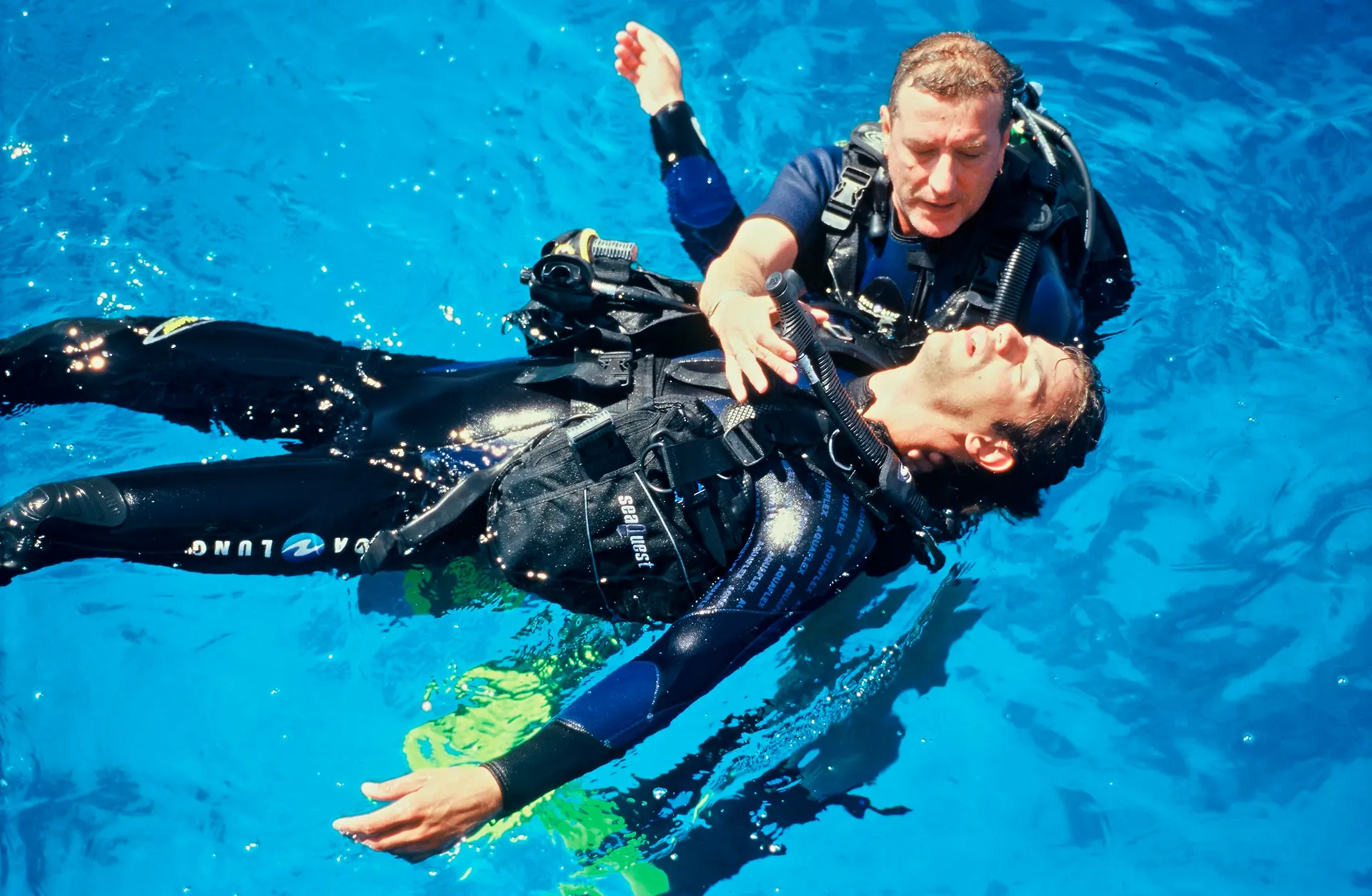
Rescue Diver
The course where it all begins… again.
 dollars
 pesos
pesos
Our prices include taxes, SDI eLearning materials, certification fees and transport to the cenotes.
Review self-rescue skills, then build toward assisting tired, panicked and unresponsive divers.
The first two training days are usually in open-water cenotes so skills can be repeated without relying on a boat schedule.
Practice scene control, missing diver search patterns, exits, oxygen use and realistic response decisions.
Finish with afternoon boat dives where your instructor tests how you manage complete rescue situations.
Complete eLearning before arrival so your Mexico time can focus on practical training.
For many people, completing the Rescue Diver course is the moment they truly begin to understand what it is to be a diver.
The course teaches techniques to avoid and manage problems, improve your confidence, and become a better buddy by recognizing potential issues and practicing dive emergency response.
What’s included
- check_circle Comfortable dive center facilities including lockers and hot showers
- check_circle Rescue pocket mask for you to keep
- check_circle Dive computer and compass for the course
- check_circle eLearning and certification fees. SDI included; PADI available as an optional add-on
- check_circle Transport to the cenotes from the dive center
-
check_circle
Tanks & weights
Nitrox tanks at no extra charge for nitrox-certified divers - check_circle Marine park fees and transportation from the dive center to the beach/cenotes
- check_circle Reef-safe sunscreen
- check_circle Lunch, snacks, and water
Good to have
- Swimsuit & towel
-
Physical sun protection
Such as hat and rashguard - Advanced certification card and CPR/First Aid proof
- Completed eLearning record
-
Confirmation of medical eligibility
Check ScubaMedical.com - Your own dive gear if you have it
- Cash to pay entry fee to the cenote
Why become a Rescue Diver?
The Rescue Diver course is very fun and physical. It is made up of three main parts: theory, exercises and scenario practice. The subject is serious, but we make the training enjoyable and practical.
You will learn skills such as self-rescue, buddy rescue, recognizing and calming potential panic divers, helping tired divers, searching for missing divers, assisting exits from the water and administering emergency oxygen.
How does the schedule work?
After you complete the eLearning, the course consists of three days of in-water training. We usually spend the first two days in open-water cenotes, where we can repeat rescue exercises without working around a boat schedule.
We can practice the skills over and over again so that you can get the most out of your training. You can stop exercises whenever you need to and repeat them as often as you want without having to worry about needing to get on the boat to move to another site.
Day 1 and 2: Exercises in the cenotes
Arrive at 08:00. We will get paperwork organized if needed, prepare equipment, then drive to a cenote for training.
We will review the self-rescue skills from your Open Water course and teach a series of rescue exercises. These build from out-of-air scenarios, cramp removal and basic self-rescue skills through to assisting unresponsive divers underwater and on the surface, searching for missing divers, helping divers exit the water and administering emergency oxygen.
On each of these days you will usually leave the cenote between 14:00 and 16:00, depending on how much we complete, how tired you are and how cold you get.
Day 3: Theory review and ocean scenarios
On your third day, we put your training to the test with scenarios in the ocean. Your instructor will not correct every mistake in the moment unless safety requires it, because we want to see how you handle the entire situation. At the end of each scenario your instructor will discuss what went well, what did not, and other ways to solve the problems faced.
You will arrive at 11:30 to go through any theory we have not already completed and conduct a thorough briefing of the scenarios we will conduct. We then go on the boat for two afternoon dives at 13:00. You will normally finish at around 17:00 after your dives, debriefing and final paperwork with your instructor.
eLearning and theory
We send eLearning to students before the course. Many people find it much more enjoyable to avoid completing the academic portion while on vacation in Playa del Carmen. When you arrive, your instructor will review the key theory points and make sure you are ready for the practical training.
While you are with us for the training, you will create an Emergency Assistance Plan. This is a plan you create to solve issues at a particular dive site.
As an SDI 5-Star Dive Center with PADI instructors available, we can teach Rescue Diver through SDI or PADI. SDI eLearning is included in the base price. Prefer PADI? Choose the PADI Rescue Diver eLearning option when booking; it costs +$1,600 more than the SDI option.
First aid requirement
To become a Rescue Diver you are required to have current Emergency First Response Primary and Secondary Care, or equivalent CPR and First Aid training from another recognized agency, completed within the past 24 months.
If you do not already have this, you can complete the training with us before the Rescue Diver course. We usually run it as a single additional day, often as the first day in a four-day Rescue schedule. The first aid course focuses on building confidence in helping people in need and increasing your willingness to respond when faced with a medical emergency.
Medical eligibility
As with all courses, you will need to complete the relevant paperwork, including a medical self-evaluation form. Please visit ScubaMedical.com where you can check your medical eligibility for diving by answering a series of simple questions.
Course details
Requirements
-
Prerequisite: SDI Advanced Adventure, PADI Advanced Open Water (or equivalent). Open Water divers with substantial recent experience may contact us to discuss options.
-
CPR and first aid: Current Emergency First Response Primary and Secondary Care, or equivalent CPR and First Aid training, completed within the past 24 months.
-
Age: Minimum age 12+
-
Medical eligibility: All students must personally verify medical eligibility before arriving. You can check using ScubaMedical.com.
-
No-fly time: You must not fly for 18 hours after scuba diving.
Plan your flights accordingly after the final training day.
Extras
-
BCD$130 per diver per day
-
Regulator$130 per diver per day
-
Wetsuit$130 per diver per day
-
Dive computer$200 per diver per day
-
SDI Rescue Diver eLearning$0 per person
-
PADI Rescue Diver eLearning$1,600 per person
-
Cenote entry feeCash on site (MXN)
Cenotes are privately owned and they will charge you an entry fee. This fee is not included in the course price. The fee should be paid in cash in pesos on arrival. The fee varies by site, typically 250-500mxn, ask us for very latest info.
Notes
- Complete your eLearning before arrival so we can keep the in-person course focused on rescue exercises and scenarios.
- PADI Rescue Diver eLearning is available for ++$1,600 compared with the SDI option.
- If you need CPR and First Aid training, contact us before booking so we can add the extra EFR day to your schedule.


